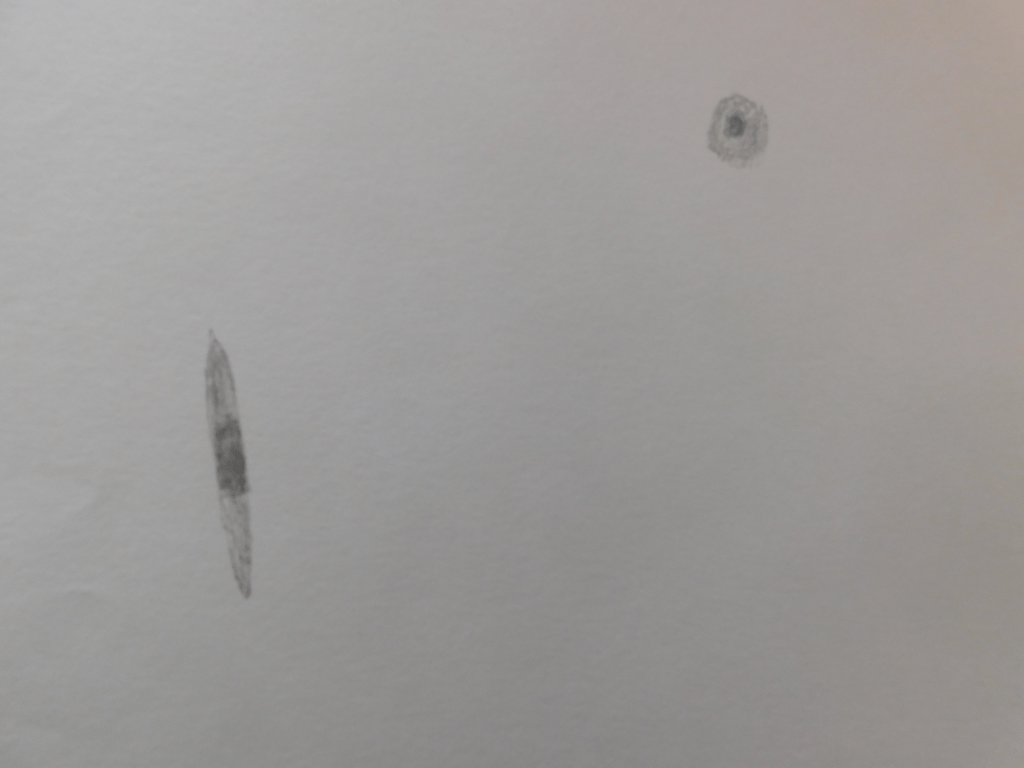
9th July 2018
These two galaxies had a level of courtesy rarely seen these days in that they are very close together, so you can see both of them at the same time through a telescope.
I remember in 2015, the year I bought my first telescope, seeing my first ever galaxy, the Andromeda galaxy. My first reaction was “there’s dirt on the mirror I better clean it”. But then I realized that when I moved the telescope right, the “dirt” moved left and vice versa. And that’s when I realized I was looking at the Andromeda galaxy. So it looked like light pollution had scuppered my chance to get a good view of this iconic galaxy. But then later, talking to other astronomers, I realized that well, even from an area with a very dark sky, the Andromeda galaxy might still look like nothing more than a smudge. When I got into astronomy sketching, I would realize that this would train my eye to see more detail in the Andromeda Galaxy and then it would be finally upgraded from its “smudge” status, but I would not take up astronomy sketching for another two years. So was this it? The wonders of the universe would look like nothing more than a faint smudge to me? No! There had to be galaxies out there that looked amazing! So that became my quest, to find a galaxy that actually looked like a galaxy.
So in August 2016, while staying down in West Cork with my telescope, I decided to do an all nighter. Spent the entire part of the night when it was at its most dark out with the telescope, then become really cold and go inside for a while and watch South Park, and then go to Wood Point to watch the sunrise. I talk about that and other sunrises I’ve seen over the years in this post:
It was a long night, and it was a cold night, but it was during this night that I saw some of my favourite astronomical objects for the first time, so many that I forgot many of them, since I didn’t do astronomy sketching at the time I had no records of what I saw, but it was during this night that I first saw the Great Cluster of Hercules,:
and the Triangulum Galaxy (I haven’t written a blogpost on that yet). But I think the highlight that night was seeing Bode’s Galaxy and the Cigar Galaxy.
Seeing these two really soothed my disappointment of what the Andromeda Galaxy looked like at the time. As you would expect, through my six inch telescope they looked nothing like what the Hubble Space telescope would see, but, they looked like galaxies, they were grey sure, but they looked like galaxies. I was looking at not one, but two giant collections of stars, planets, black holes and who knows how many other wonders, that were 12 million light years away.
How far away is that? When the light you see from these two galaxies started its journey to Earth, the genus Homo did not yet exist, and would not exist for another ten million years:
https://en.wikipedia.org/wiki/Homo
Imagine trying to adapt to a time two million years ago, where the closest thing to a modern day human was the Homo Erectus. Now imagine a time when even Homo Erectus was an improvement in terms of having somebody to talk to. The only animal even remotely similar to a human 12 million years ago was this:
https://en.wikipedia.org/wiki/Danuvius_guggenmosi
So an alien alive today in the Cigar Galaxy, if they had a telescope powerful enough to see Earth (this is assuming they somehow have a telescope powerful enough to see Earth in detail from 12 million light years away and yet are not technologically advanced enough to get past speed of light limitations, just go with it okay!) might well conclude that Earth will never produce a technologically advanced society.
Now we’re going to talk about starburst. Not the method of faster than light travel in Farscape, (though you should watch that show because it’s awesome), and not the sweets formerly known as Opal Fruits (though you should eat them because they’re awesome, it’s years since I’ve had them in fact, memories!). No, I’m talking about what’s going on in the Cigar Galaxy. In the galaxy’s center, stars are being born ten times faster than they are being born in the entire Milky Way galaxy:
https://www.newswise.com/articles/happy-sweet-sixteen-hubble-telescope
Awww that sounds kind of adorable doesn’t it? But maybe it’s kind of violent and wrong. Bode’s Galaxy is so close to the Cigar Galaxy that its gravity has deformed it, and its gravity is also what’s causing the Cigar Galaxy to produce so many stars. So, em, eh, okay, moving on swiftly!
Bode’s Galaxy at its center contains a black hole fifteen times bigger than the black hole at the center of the Milky Way galaxy, and it’s seventy million solar masses:
https://www.nasa.gov/feature/goddard/2017/messier-81
I’d like to stop for a moment and reflect on the fact that, astronomy never ceases to amaze me. I don’t think I’ll ever get so used to learning this stuff that it’ll all become meaningless numbers. I was in such amazement of the black hole in Bode’s Galaxy that I had to double check to make sure I understood properly, but yes, the black hole in the center of Bode’s Galaxy, is seventy million times bigger than the sun!
And maybe that’s what I love about astronomy. It brings your simple human brain into places where it’s not supposed to go, for a simple homo sapien’s brain this stuff is incomprehensible, and amazing, and wonderful. When you’re looking at the Cigar Galaxy and Bode’s Galaxy, you are looking at things that are older than you can imagine, and bigger than you can imagine, and this is just one tiny part of the entire universe. When you are looking at these things that are too big and vast for our brains to comprehend, you might as well be looking at one corner of one room of a giant mansion. And it’s amazing to think that I was able to witness such amazing things from a backyard using a relatively inexpensive telescope.

 Ponderings Of An Autist
One thought on “Bode’s Galaxy and the Cigar Galaxy, Two For The Price Of One”